


Geothermal (aka Geoexchange)
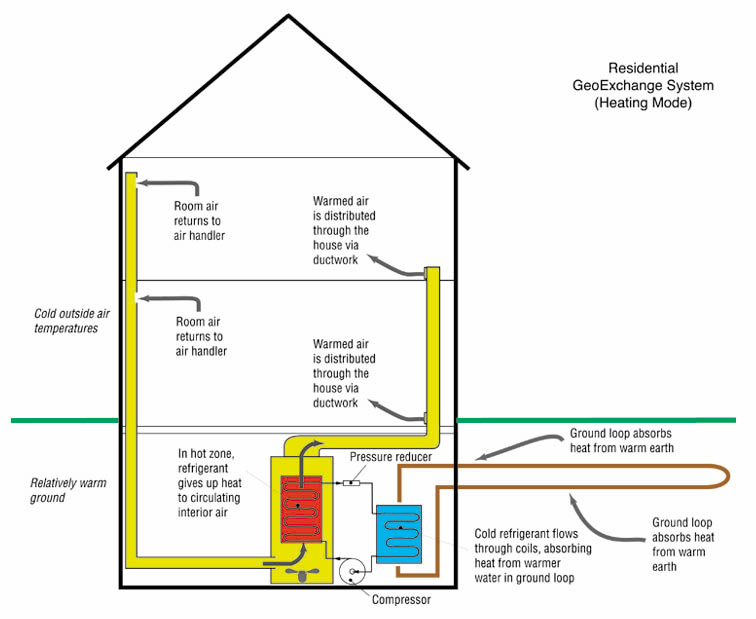
What it is:
Geothermal heat pumps, also known as ground source heat pumps or geoexchange systems, are used to heat and cool homes, commercial buildings, etc.. Heat from the ground (or in some cases, groundwater) is used for heating in winter, and in summer the ground can be used as a “heat sink” for heat removed from the building.
How it works:
For heating, geothermal heat pumps use electrically driven compressors to boost the temperature of fluid from at or near ground temperature to a temperature where it is useful for heating. This boost in temperature is accomplished by compressing refrigerant, raising its temperature. The closer the incoming fluid temperature is to the output temperature (radiators, hydronic coils, etc.), the more efficient the heat pump will run. Heat pumps will operate in a range of efficiencies through the heating season, usually starting high, and losing efficiency as the winter progresses. Ground temperatures can drop from 50°F to below freezing, thus antifreeze is necessary in some ground loops.
It’s common to size a geothermal heat pump for 60-80% of the heat load, with additional heat provided on the coldest days by a supplemental source, such as electricity or propane. A set up like this can lower the upfront costs by reducing the size of the equipment, and the amount of drilling or trenching that’s required. It also creates a situation where the heat pumps will have long run times through most of the winter, rather than frequently cycling on and off. Long run times lead to better efficiency.
Although electricity used to operate geothermal heating and cooling equipment is usually not renewable, the thermal energy moved from or to the ground while the heat pump operates is renewable. Electricity is needed to operate the heat pump. Depending on the system design and the heat load of the building, the amount of electricity used can be significant and expensive. As most electricity today is produced with fossil fuels from power plants that are only about 30% efficient, the gains made by using renewable, clean geothermal energy can be completely canceled out by the losses at the powerplant. If the electricity used to run the geothermal heat pump is from renewable sources such as wind or hydropower, then the geothermal system becomes the best choice for having a neutral environmental impact.
Advantages:
- Can be set up for extremely efficient operation.
- Can be used to heat and cool.
- Geothermal uses renewable energy.
- Clean operation. No combustion on site.
- Long Life (50+ years for a closed loop ground loop)
- Low maintenance (for a closed loop ground loop).
- No noisy outdoor units such as you would find with standard AC.
Disadvantages:
- Very costly to install.
- Not a good solution for retrofits, which typically require high output temps (lowering efficiency substantially)
- One-third or more of heating energy derived from electricity which is expensive
- Units must run at low output temperatures (100-110°F) for good efficiency.
- Some ground loop types lower water table and often have high maintenance expense
Ecological Impacts:
The most important impact is related to the electrical energy produced to run the heat pump. Geothermal heat pumps use electricity to run compressors that raise the temperature of the refrigerant to the desired output level. The higher the output temperature, the more electrical power is consumed. Most electricity in the northeast is produced with non-renewable fuels. According to the Dep’t of Energy, electricity power generation and transmission is only about 32.5% efficient. A further 3% being lost in fuel transportation to the power plant. That means that about 71.5% of the energy contained in the fuel for making electricity is wasted.
A second impact, seen with “standing column wells”, is that well water must be pumped out of the ground to raise the well temperature so the heat pump doesn’t lose efficiency (or even freeze). This affects the water table (it can lower it).
Special comments
You’ll occasionally hear about another type of heat pump: air source heat pumps. These heat pumps do not have a ground coupling; they use the air for a heat source (heating) and heat sink (cooling). They are actually very much like refrigerators except they reverse for heating and cooling and use outside air for heat source and heat sink. Air-source heat pumps are less expensive to install than geothermal systems because they don’t have a ground coupling. However, they are not as efficient as geothermal systems when the outside temperature is either cold or hot. They work very well for heating when outdoor temps are 45°F and higher, and for cooling when outdoor temps are below 90°F. Outside of these parameters, the efficiency of these systems drops off significantly.